Thursday, October 3, 2013

Bamberg

Bamberg is an amazingly beautiful city. The city is in northern Bavaria, located in Upper Franconia on the river Regnitz close to its confluence with the river Main. Its historic city center is a listed UNESCO world heritage site due to its impressive architecture.  The city is over 1,000 years old and was not bombed during The War thus preserving the oldest buildings.  Population of Bamberg is 70,000 plus 18,000 university students.  
Bamberg is also home to the smoke, or Rauchbier and is home to eight breweries, Brauerei Fässla, Brauerei Greifenklau, Brauerei Heller-Trum (Schlenkerla), Brauerei Kaiserdom, Keesmann Bräu, Klosterbräu, Mahrs Bräu and Brauerei Spezial, and one brewpub, Ambräusianum. The first time I had the smoke beer from Schlenkerla was almost 20 years ago and I put it on my list to find my way to drink it fresh at the source.  It was better than I could imagine especially as it came with a conversation about the history of the brewery (established in the early 1400's) from sixth generation brewmaster, Mathias Trum.  Mathias is in his early 30's and talked to our group about the history of the brewery and how the malting process, which includes kiln drying over beechwood, imparts the smoke aroma and flavor into the malted barley.  People love or hate this beer, I tend to love it.  We had a great dinner with the Marzen Rauchbier last night.
Today is a holiday in Germany celebrating reunification.  I will never forget sitting in my dorm at WSU with a huge group of students cheering as students in Berlin tore down the wall in November 1989.  October 3rd is the day of celebrating the reunification of East and West Germany and was established as a national holiday in 1990.  All stores and banks were closed today, but all the cafe's and restaurants and of course pubs were open.  In Bamberg it is celebrated with a huge antique bazaar that spans several city blocks and lines most of the streets downtown. We had a wonderful walking tour of this city today and learned about the history and geography of the region.  We found gelato at a sidewalk cafe and enjoyed the sunshine as we explored this wonderful city.
Old city hall sits in the middle of the river. 
Lantern above the entrance to Schlenkerla
Mathias telling us about his brewery and beer at Schlenkerla
Part of the castle and cathedral in Bamberg, a very Catholic city
Antique bazaar on day celebrating reunification. I couldn't bring myself to buy the bier stein made in 1880 with a pewter top.. 200 euros was too much today, but it was awesome.
Rooftops of Bamberg
Beautiful fall day!
Prost! From Braueria Spezial


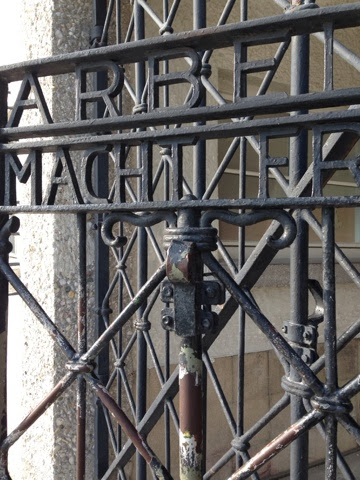
Dachau

Work will set you free. 

Today was hard. We got up early to catch a train and bus to Dachau. I've said it before, but it bears repeating. You think you are ready for what you will see. The fact is you simply aren't and I hope that none of us ever will be. The weather was beautiful and it was a crisp fall day. I felt so confused by how good it felt to be outside and so aware of the pain and suffering that went on inside some 60 years ago.  The memorial is beautiful as well, as much as you can say that about a concentration camp. Beautiful in its simplicity. The camp, the museum, the barracks, the artwork, religious monuments, and the crematorium were simply overwhelming. I'm glad I went, and I hope everyone gets a chance to do so if only to remember that this should never happen again. 

I can't go into detail into what I saw. But, I was struck by the smallest things. A prisoner's glasses, a belt, a picture of a beautiful woman taken from a prisoner upon admission. 

I also know that I will never take my freedoms for granted. 

-KB

I share the same observations as Kathy. Another takeaway for me was was the part of our tour that presented the liberation of Dachau by American forces. The prisoners had heard the gunfire for a couple days then silence. Then waiting and more waiting for a very long day until the rumble of tanks and the arrival of the Americans late in the afternoon, April 29, 1945.  We read accounts of anticipation by the prisoners and tales of horror by members of the U.S. Seventh Army's 45th infantry division.  It was a time of unselfish sacrifice by our country. Men and women gave their lives to save others in the War. It's sad to think that perhaps the US has become a country of selfish and self serving people willing to shut down the government.

To think about the proud Americans spreading freedom across Europe and compare those brave soldiers and their families to the members of congress today I can't help but think we are so much more than what we've become...

-AH


Tuesday, October 1, 2013

Munich - Oktoberfect


Our Oktoberfest day began with a waking tour of Munich. One cannot walk around a corner in this city without being slapped in the face by history. Not just the WWII time period that we tend to associate with this region, but with kings and royalty dating back to the 800's.  Munich was once a place where the Jesuit Catholics preached and created a stronghold for Catholicism in Central Europe. Munich's architecture ranges from old and gothic (that which survived the war) to very modern and 21st century.  One area that hit us like a ton of bricks was when we passed the cornerstone which remains of a former Jewish synagogue.  Early in his tyranny Hitler often stayed at a hotel/club adjacent to the holly place. He convinced the decision makers of the time that the synagogue was in the center of a high traffic area and that it should be torn down. Dismantled it was, by the Jews who prayed there, brick by brick.  This part of Munich is haunting.
We were so glad that this won't be our memory though. Our experience at Oktoberfest was incredible and multi-cultural with people from all parts of the world and religious faiths and cultures coming for a HUGE party. 
Oktoberfest is the world's largest fair held annually in Munich, Bavaria, Germany. It is 16-day festival running from late September to the first weekend in October with more than 6 million people from around the world attending the event every year. To the locals, it is not called Oktoberfest, but "die Wiesn", after the colloquial name of the fairgrounds (Theresienwiese) themselves. The Oktoberfest is an important part of Bavarian culture, having been held since 1810. Other cities across the world also hold Oktoberfest celebrations, modeled after the original Munich event. Crown Prince Ludwig, later to become King Ludwig I, was married to Princess Therese of Saxe-Hildburghausen on October 12, 1810. The citizens of Munich were invited to attend the festivities held on the fields in front of the city gates to celebrate the happy royal event. The fields were named Theresienwiese ("Theresa's meadow") in honor of the Crown Princess, and have kept that name ever since, although the locals have since abbreviated the name simply to the "Wies'n".
Only beer conforming to the Reinheitsgebot, at a minimum of 13.5% Stammwürze (approximately 6% alcohol by volume) may be served at Oktoberfest. The beer must also be brewed within the city limits of Munich. Beers meeting these criteria may be designated Oktoberfest Beer. 
Oktoberfest is PARTY atmosphere. Everyone seems happy and festive(it could be because beer is poured only in liter mugs). We started our afternoon at the Augustiner tent where we had the Augustiner fest-bier, giant pretzel and roasted chicken.  In the center of the tent (hardly a tent in that it holds 8,000 people) is a bandstand where a 16 piece orchestra played traditional music.  After our lunch we made our way to the midway and jumped on the Ferris wheel for an incredible view of the city and the Oktoberfest fairgrounds. We then wandered around the fairgrounds and developed a terrible thirst so we made our way into the Hofbrau Haus tent.  This was clearly where the young people go.  Tables in a standing area provided easy access to beer and people watching and singing and dancing.  We enjoyed watching young men attempting to show their bravado by standing on the tables and drinking their liters of beer in one drink. If they pulled the mug away from their mouth before it was empty they were booed horrendously and people threw parts of pretzels at them in disgust. At our table we were surrounded by Australians who make and annual pilgrimage to Munich for the party.  We mingled with locals from the Munich area including Patrick and Hannah and Tina who announced us as best friends before jumping on the table to chug beer. The French people we spoke to on the other side of the table were not impressed by this show although they admitted to being on their 4th liter of the afternoon. They drank with more "dignity" it seems.  We loved being here in a diverse sea of humanity and we enjoyed meeting people from around the world, all with a happiness and joy in celebrating being here together.
We ended our Oktoberfest day with a walk through the city ending up at the Hofbrau-Haus beer hall in the city.  It felt a bit odd to end our day of celebration in a place that was once a rallying point for the nazi party.  Drinking a beer where Hitler often gave speeches and looking at the ceiling once adorned in swastikas now painted over in blue and white was a reminder of what this city ONCE was but is no longer. When we look around at the tables here we see people of Asian, Jewish, Middle Eastern and African descent.  People spoke english with accents ranging from Australian to British to American and we of course could pick out conversations in German and French and Russian.  Oktoberfest is the best of the world. Differing backgrounds being happy together.
We will return to Munich and Oktoberfest again. What a great party!
Tomorrow we head to Bamberg by way of Dachau. We may or may not post depending on the heaviness of the day. 
Glockenspiel - amazing mechanical moving parts when the clock strikes noon
Cornerstone if what once was a synagogue at this location before WWII
Must have big pretzel at Oktoberfest 
Big beer, big pretzel
Augustiner beer tent
View of Oktoberfest fairgrounds from the Ferris wheel 
KB on the Ferris wheel 
Hofbrau tent
Music stand at Hofbrau tent
Watch out for the Australians at Oktoberfest 
Kathy and Hannah - we just met
Patrick and Tina, new best friends we just met
A liter is equal to Kathy's head is seems
The ceiling at Hofbrau Haus. 


Monday, September 30, 2013

Our triumphant arrival in Munich.

The beautiful farmhouse in Eck was left behind in the morning on Monday as we headed to our first of two breweries to visit before arriving in Munich.  Our first stop was Schneider Weisse, home of some amazing wheat beers, for a tour of the brewery before lunch.  The brewery came into being around 400 years ago and was subsequently purchased by the first Georg Schneider around 7 generations of Schneiders ago.  The brewery has been in the family since then and the current Georg, Georg VI, is in charge today. Georg VI is also an artist and designed the labels of the many beers here to artistically reflect their content. I have a feeling he wanted to be an artist but had to stay in the family business. I'd feel bad for him, but his family business is beer so I think we will be okay.  We tasted many wonderful beers here and were very impressed that Georg uses Cascade Hops from the U.S. in some of them. 

After a great lunch which featured a guest appearance of Georg VI who kindly stopped by to say hello, we wandered the village and its church before heading to our next destination - Weltenburger Kloster. 

The Weltenburger Kloster is a monastic brewery that dates back to 1050.  Located on the Danube, it is scenic and soaked in history. The Romans built a temple to Minerva on the hillside, which was later replaced with a chapel, and which later became a Benedictine Abbey. Today seven monks remain on the premises and the brewery is a wonderful tourist destination. We toured the church on the premises which was the most ornately decorated church I've ever seen. After being inspired, we enjoyed some monastic-brewed beer in the courtyard and soaked in the scenery before departing to Munich. 

Arriving in Munich, we had one goal. Find the Andechser am Dom and have a beer. This lovely place is affiliated with another monastic brewery which we wanted to go to but won't have the time. Instead, we went to the Marienplatz and strolled to the Andechser am Dom for a pretzel, sausages, beer, and schnapps. It was lovely. We walked through Oktoberfest revelers - some drunk, some on their way - and enjoyed every moment of it. Sometimes it just hits you, we are in Munich and it is magical. Tomorrow we will attack Oktoberfest. 

The Biergarten at Schneider Weisse. 

Those wacky Germans. 
A happy beer man on the tour. 
The tastings were much enjoyed. 
Georg VI and the beer guy. 
St. George v the dragon in the Weltenburger Kloster church. 
The church's ceiling. 
Dinner in Munich. 

From Bohemia to Bavaria

This post will be a bit shorter as we need to run to catch our bus to Munich.
On Sunday our time in Prague came to an end as we boarded a bus and headed towards Germany. On the way to Germany we made a must stop at Pilsner Urquel brewery in Pilsen, about 100 km Southeast of Prague. We were told that Pilsen in the second largest city in the Czech Republic. I have always wanted to visit the Pilsner Urquel brewery. The beer, made with Saaz hops of course, has influenced lager makers in the US for years. This brewery has continued the same triple decoction mash process for years and they malt the barley on site. However, they no longer use their cellaring caves for storage except for beer sold at the brewery restaurant. They have moved to the more common upright conical tanks which are outside the brewery. Our tour of the brewery included the newer facility and process as well as a trip through the cellars which seemed to extend for miles. The extensive amount of cooperage necessary to make the amount of beer to send around the world filled the cellars at one time. After the brewery tour we had lunch at the restaurant on the Pilsner Urquel grounds.  We had traditional czech meals, mine being a perfectly braised goulash and Kathy a venison stew.  Perfect pairing to the beer fresh at the source!
After lunch our bus took us southwest into Germany and into the Bavarian Forest.  The landscape of rolling hills and dense forest cut by small villages and farmland was beautiful.  We see pictures of these small towns with houses of red rooftops and a church steeple in the center of town, but not until we see it do we put into context the history of this land.  It is a privilege to travel through this part of Germany. We ended our day in the middle of the Bavarian countryside at Brauerie Eck.  Eck has a hotel, pub and brewery in the middle of the countryside that has been here since the 1462. Garret, the owner and brewer is direct descendant of the family that built the brewery and it has been in the family for generations.  The Eck beer is available only at the brewery and it is clear that it is part of the fabric of this community.  After a tour of this small brewery we had dinner in the restaurant surrounded by locals from the neighboring town.  I finally found Sweinehax'n, based on recommendation from my boss Bill Hanson, slow roasted pork knuckle and it was amazing proving Bill really does know all.  KB had the schnitzel and wwe both enjoyed the award winning Dunkel made by Garret who is a very talented brewery.  It should be noted that the days of the Saaz hops are behind us.  That was so Czech. Now (including Eck) the beer will feature the less spicy and more flowery Hallertau.
Today we are heading to Munich via Schneider, and Kloster Beltenburg.
We have been blessed by amazing weather, sunny and mid-60's every day. Autumn in Germany - who knew?  
Pilsner Urquel Brewery
Arlen in the old Brewhouse
Kathy in the new Brewhouse
Old cellars at Pilsner Urquel
Open fermentation for tourists and locals only
Best Czech tour guide EVER!
Cellar rats
Loving our Pilsner Urquel fresh from the source
Village next to Eck farmhouse brewery
Bavaria is awesome!
Garret, owner and brewer
Sweinehax'n with kraut and potato dumplings for Bill


Saturday, September 28, 2013

The last day in Prague.

Saturday was St. Wenceslaus day here in Prague. I'm sure you were all celebrating good king Wenceslaus in your own way and don't need any explanation as to the holiday. But for the few of you who need a refresher, Wenceslaus I was the duke of Bohemia from 921 until his assassination in 935, purportedly in a plot by his own brother, Boleslav the Cruel. Here's the thing, if your brother is named "the Cruel," you will probably want to keep sharp objects away from him. 

After his death Wenceslaus I was elevated to sainthood, posthumously declared king, and seen as the patron saint of the Czech state. He is the subject of Good King Wenceslas, a Saint Stephen's Day carol written over 900 years later, in 1853, that remains popular to this day and which most people know one or two lines of before they resort to humming. 


The day involved more than solemnly remembering King Wenceslas because there was a castle to storm. We walked to the castle via the famous and picturesque Charles Bridge. The Charles Bridge crosses the Vltava river and dates back to 1357. 


Along the sides of this pedestrian-only bridge are 30 statues in the baroque style. It's simply beautiful to walk along the bridge and look back into town, look down over the river and the boats and swans thereon or look up to the castle that looms overhead. 


The bridge is not just baroque architecture; it also features a modern trend called love locks. What are love locks? Well, when a couple love each other very, very, much, they fix padlocks on fences, gates, and in this case, a bridge. They put their names or initials on the padlocks and throw away the key. As such, they are locked together through time without the embarrassing permanence of a tattoo. It is at this point of the story that I have been asked to clarify that no one involved with this blog put a love lock on the bridge. 


The castle itself was awe inspiring. It is the largest ancient castle in the world and dates back to the year 870. The Kings of Bohemia, Holy Roman Emperors and presidents of Czechoslovakia and the Czech Republic have had their offices in the castle and it was occupied by the Nazis during WWII. Today it is the seat of the head of state of the new Czech Republic. You can't deny how inspiring it is and how it would have sent a message of power to those viewing the castle from below. Most castles are built to send a message of strength and this imposing building looking down on the city is no exception. 

The castle completely encloses the gothic Saint Vitus Cathedral which we didn't get to visit because we arrived before it opened. We were, however, able to climb the tower in the cathedral. All 287 steps of it to the very top and it's panoramic views of Prague. I have a fear of heights yet I find it necessary to climb every tower I come across. My legs shook the entire time but I knew I'd regret not doing it. 


After our visit to the castle grounds we departed via the gardens which would be spectacular in the spring and summer but which are settling in for the winter. Still, it was a beautiful walk back off the grounds and back to town for lunch. 

We ate and drank at a Prague gastro pub where we enjoyed the best meal of the trip. Then we went to a local microbrewery where we shared a sampler tray. I didn't care for the banana beer or the nettle beer, but the coffee beer was great. The evening was spent with our tour friends as we soaked up our last night in Prague and prepared ourselves for our journey to Germany. Tomorrow we bid adieu to Prague and we head to Plzen to taste the original pilsner then to Eck in north-eastern Bavaria. 


Random observations: 

The big thing to buy here in Prague is glass - cut crystal or blown glass. You can get the stuff everywhere. 

Smoking is allowed in the bars here. It's given me a new appreciation for the clean indoor air act. 

I have been here for 3 days now and have yet to eat gelato.